

By  Megan Banta
| Sep. 6, 2026, 7:00 a.m.
The builder acknowledges it ‘might be a little hard to replicate’ — but still hopes the philanthropic model can serve as a model for other affordable housing efforts.

An affordable housing development in Lehi hopes to be a case study for how builders and philanthropists can scale a solution to Utah’s housing crisis.
Innovation Park at Holbrook Farms combines philanthropic funding, donated land, private development and city cooperation to create workforce townhomes in one of the state’s fastest-growing communities. The project also includes a literacy center, bringing together two community needs that often are addressed separately.
This approach is known as place-based philanthropy — focusing charitable resources on the needs of a particular community and bringing together the partners and capital needed to address them.
It’s an approach backed by the National Housing Crisis Task Force, which Gov. Spencer Cox co-chairs.
The Lehi development might be “a little bit hard to replicate,” said Clark Ivory, CEO of Ivory Homes and co-founder of Ivory Innovations, which partnered with Call to Action Foundation to fund the project.
But its backers still hope it can be a model for other projects.
No government funding
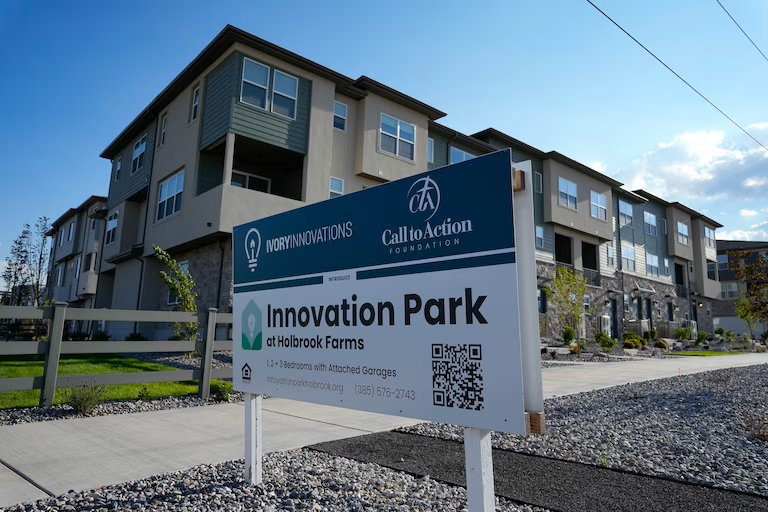
Innovation Park has 200 townhomes — with 39 more under construction — that cater to nurses, teachers and first responders being priced out of the communities they serve.
Rents range from $1,231 to $1,979, and many of the townhomes are set aside for people earning well below the typical income for the area, Ivory said.
But the development didn’t use any government funds.
Ivory Homes donated the land for the affordable townhomes, which sit in a broader development that includes luxury homes. The rest of the funding came from Ivory Innovations and Call to Action.
The development also has a higher density than other for-sale projects at 22 units per acre.
“It’s not quite apartment density, but the density itself helps so you can still do a townhome and keep it pretty competitively priced,” Ivory said.
They also didn’t put in additional amenities, like a pool or tennis courts, that have ongoing operational costs.
A combination of those and other factors, Ivory said, made it so they “basically built these townhomes for similar prices to what it’s costing to construct an apartment.”
‘What people really need’

While kids in the community might not have a place to splash around in the summer, the developers’ place-based philanthropy led to build another amenity — a location for free tutoring.
“We’ve got to think about what people really need,” said Christine Ivory.
Instead of a pool, the two groups and the Clark and Christine Ivory Foundation built a satellite location of the Rippy Literacy Center on the grounds.
That’s meeting two needs, both Ivorys said, by providing affordable housing and helping address a growing problem as literacy rates decline among Utah kids.
And it’s the whole point of place-based philanthropy, which concentrates resources in a particular community, bringing together partners from different sectors and coordinating them around local needs.
A new way?
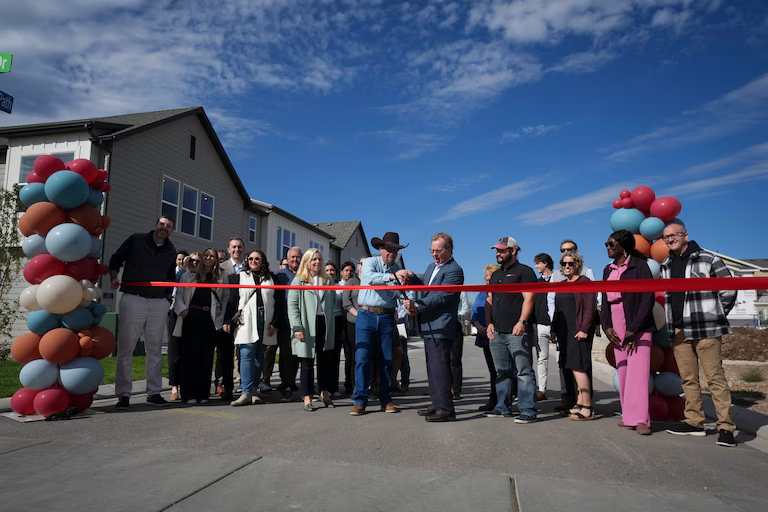
Though homebuilders have helped in times of need, especially after natural disasters, Innovation Park represents a different use of that money.
The Ivories hope the development can serve as an example, though they’ve gotten more interest from other cities about the model than from builders.
That’s key, though, because it “really takes a public-private partnership to pull this off,” Clark Ivory said.
Lehi didn’t give government funds, he said, but did work with them throughout the process, including on amenity requirements.
“There’s a lot of things cities can do that don’t cost money,” Clark Ivory said.
Most of builders’ problems and challenges, he said, come from friction in the approval process.
That needs to change for there to be more affordable housing, he said – Utah “can’t just keep doing it the way we always have.”