

BACKGROUND AND GUIDELINES
Introduction
One way to address the region’s environmental sustainability and housing affordability issues is
to build smaller houses. Cottage housing is an innovative style of development based on the idea of “better, not bigger.” Although it faces the same obstacles as other higher density development types, cottage housing’s advantages could make it more acceptable to neighbors. This develop- ment type would be a useful option for developers, fitting between the detached single family house and the condo or townhouse. It makes more efficient use of the land, is more affordable and offers better energy efficiency than traditional single family detached housing, while providing more pri- vacy than attached housing.
What Is A Cottage Housing Development?
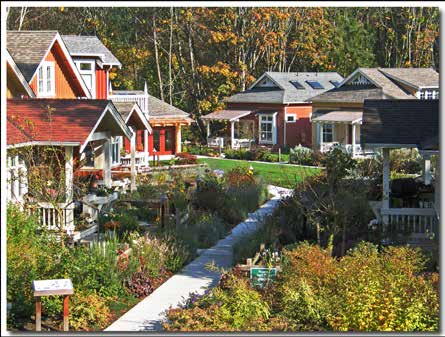
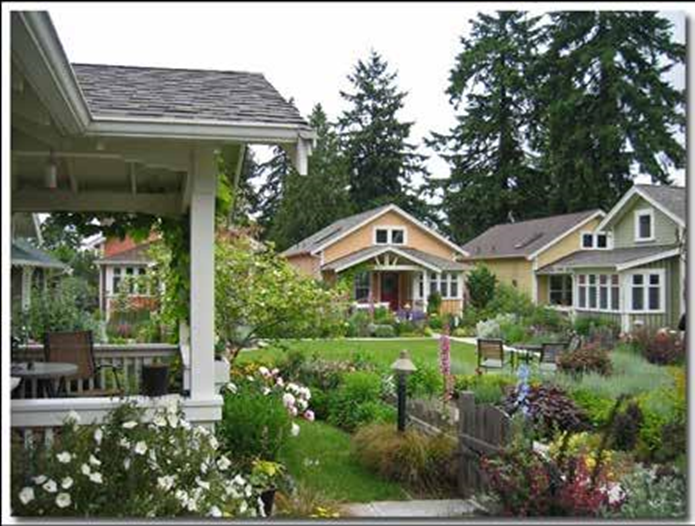
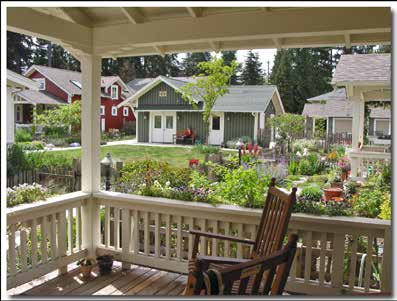
A Cottage Housing Development (CHD) is a collection of small houses—usually less than 1,000 square feet in gross floor area. The cottages are arranged around a common open space, or court- yard, with parking screened from public view.
The first modern cottage developments occurred in the Pacific Northwest in the 1990s with the re- habbing of several 1916 rental cottages into single family homes. The same group of architects and developers built the first “pocket neighborhood” in Langley, Washington in 1995, following the city’s adoption of the first CHD zoning ordinance. Since then, cottages have appeared all over the North- west. They have been authorized by ordinance in Seattle and many of its suburbs. Other examples come from Anchorage and Juneau, Alaska, Boston, Cleveland and Nashville.
Developer Jim Soule, who built those first cottages in Washington, described a cottage housing development as “a group of homes that face and relate to one another around a landscaped common area—the old bungalow court approach” (Cottage Living, April 2008).
Smaller houses are not new to the Lehigh Valley. The post- World War II bungalows Soule mentioned are plentiful in the area. Many of these houses are 1,200- 1,500 square feet. Some local neighborhoods huddle around a public park, similar to the clustering found in a cottage development. Recently, several age-restricted communities have used some of the elements of cottage housing, such as clustering or small unit size.
Cottages can be as comfortable to live in as a large house because they eliminate parts of a house that smaller households don’t really use. For example, a cottage doesn’t have a great room and a living room and a sitting room, or a casual dining room and a formal dining room and a breakfast nook. Cottage designers often find ways to make the most of the space, building shelving into walls and living space into lofts. Front porches extend the house outside.
Cottages gain their efficiency through higher densities, so they are usually permitted at double the normal density for single family detached homes. They can be built either on individual lots, or on a single lot, like condominiums. They can have attached garages or shared parking. This flexibility allows cottages to fill a number of roles in a community:
- Townhouses without shared walls (multi-family detached);
- Moderately priced housing;
- Urban infill—making use of smaller parcels;
- “Downsized” housing for empty-nest families looking for smaller units;
- Upscale housing, where floor space is traded for higher quality amenities;
- Energy efficiency
| Table 1 | ||
|---|---|---|
| Cottage Housing vs. “Conventional” Housing | ||
| Character-istic | “Conventional” Housing | Cottage Housing |
| Density | Less than eight units per acre. | Double underlying zoned density. |
| Unit orientation | Facing out on a public access street or cul-de-sac. | Facing in on a common open space, in a cluster of 4-12 units. |
| Floor area | Typically, 2,500 sq. ft. and up. | No more than 1,200 sq. ft. |
| Common open space | Either provided onsite or a fee is paid to the municipality for improvements to parks offsite. | Per unit common open space requirement. Cottages are required to be clustered around the open space. |
| Design restrictions | Few. | Design standards are needed to make cottages more acceptable to neighbors. |
| Ownership | Fee-simple. | Fee-simple or condominium association. |
| Parking | Garage facing the street; two spaces per unit. | Shared parking or individual garages permitted,but buffered from public view and accessed via alleys or private driveways. Parking requirements can be reduced for smaller cottages, to encourage singles and families without children to occupy them. |
| Zoning | Single Family. | Medium density single family to medium density multi-family. |
| Footprint | Maximum lot coverage. | 850 sq. ft. maximum footprint. |
| Second floor | Typically, up to 35 ft. overall height. | Cottages limited to two stories. Living space directly under the roof is not uncommon. Height restricted to 25 feet. |
| Porches | Not required. | Required. |
Advantages
The advantages of cottage housing are typically related to the efficient use of land. Cottages can
make the most of a smaller piece of land through their compact size, making them an ideal choice
for urban infill development. If cottages are permitted at higher than usual densities, they begin to
show their qualities. CHDs are arranged in clusters of four to 12 units, built around a central open
space. Parking is required to be hidden from view, either with garages that open onto alleys, or
shared parking lots protected by landscaping or other features. If the cottages are clustered densely
enough, the cost per unit will come down to below neighboring houses, even though the cost per
square foot is typically somewhat higher.
This makes them a good starting point for workforce housing. Several recent af- fordable housing providers have taken advantage of the cottage concept (see the de- velopment case studies on page 5). In the past, housing was more affordable partly because the houses them- selves were smaller. Cottage housing can recapture that strategy by scaling a house’s size and amenities to fit the price requirements of different market segments.
On the other hand, cottages can also be built without affordability in mind. Upscale cottage developments are common in some of the most affluent communities in the Northwest.
These projects have taken the cost savings that come with a CHD’s higher density and put it into
higher quality amenities—an approach of “better, not bigger,” as highlighted in Sarah Susanka’s
“Not so Big House” series of books. In Kirkland, Washington, cottage housing was used to diversify
a housing market that was being overrun with enormous mansions.
Cottages can be much more energy efficient than large houses. At least two affordable housing
projects have used cottages to enhance the affordability of the units by reducing energy costs.
These developments used new technologies and the small sizes of the structures to access support
from power companies or environmental organizations. Small cottages are energy efficient because
there is no excess space; owners do not have to pay to heat rooms that they rarely use.
Challenges
On a per-square-foot basis, cottages are more expensive to build than large houses. This poses
a direct challenge to the goal of using cottage housing to make homes more affordable. Cottages
contain all the same expensive parts of a conventional house—kitchen and bathrooms—but none
of a builder’s typical profit centers—sitting rooms, dining rooms or extra bedrooms that add to the
price of a house but are cheap to build. Another factor in the higher cost of many CHDs is the inno-
vative nature of the concept—builders are trying to showcase the idea. In order to be economically
viable, CHDs need to be built at per-unit densities close to those found in multifamily developments.
The two most common approaches to increasing cottage density are to either double the underlying
zoned density if cottages are built, or to allow more than one cottage on each lot.
Allowing CHDs in single family districts with public sewer and water greatly increases the viability of
cottage developments. However, the building of cottages close to larger homes can be the source
of public resistance. Many of the arguments raised against smaller or denser housing have been
aimed at cottages: they are ruining the “character” of the neighborhood; increased density will bur-
den the school system; property values will fall; traffic will increase. While some neighbors in Shore-
line, Washington complained about cottages being built next door, the Kirkland study found solid
public support for two well-designed developments. Also, it is unlikely that CHDs will add many children to the school district, despite the higher density, since these small units are designed for seniors, singles and couples with one child at most.
Cottage design has drawn opposition in some cases, with the look of the buildings becoming a focal point for neighbor resistance. While a focus group study of cottage residents and neighbors in Kirkland was positive, one resident told the City Council that “They look like they should come with a pair of Birkenstocks and an elf (Kirkland Reporter, 12/27/2007).” Brightly colored cottages in Shoreline and Anchorage, Alaska also drew fire for disrupting the neighborhood. However, one CHD in Seattle used a publicly viewable garden as a way to share its assets with the community and win neighbor support. Most municipalities have incorporated strict design requirements into their CHD ordinances as a way to address opposition to the cottages’ aesthetics.
The included model regulations address some brief design requirements, however, each municipality should use its own local standards to ensure the cottages are compatible with the rest of the community. Some design criteria could include provisions such as:
- Limits on the pitch of a cottage’s roof;
- A maximum ratio of height to width (to avoid tall, skinny houses);
- Requirements that each cottage look different from its neighbors;
- Restrictions on color schemes.
Development Case Studies
Shoreline, WA. Greenwood Avenue Cottages. The most successful of the seven CHDs
in Shoreline, the Greenwood Avenue cottages sold quickly in 2002. Initial prices ranged from
$250,000 to $285,000, although a recent resale was listed at $439,000. The eight units are all less
than 1,000 sq. ft. in usable floor space (the second story is under the shallow pitched roof, so the
square footage includes only the space with at least six feet between ceiling and floor). The units
are clustered around a large common green space that also includes a 300 sq. ft. community build-
ing. Parking is clustered to either side. “Builder Online” praised the cottages for their use of “cheer-
ful, but not overwhelming, colors,” however, during the city’s debate over CHDs, some residents
complained that they were gaudy.
Suffolk County, NY. Cottages at Mattituck. This 22-unit subsidized CHD opened in October of 2007. The Community Development Corporation of Long Island developed the income-restricted, workforce housing project with county bonds, Federal HOME dollars and a subsidy from the Long Island Power Authority that reflected the high energy efficiency of the designs. The 1,100 sq. ft. units sold for $175,900 for buyers making less than 80% of the median income and $218,400 for buyers earning from 80-100% of the median. Deed restrictions will keep the units permanently affordable.
Cleveland, OH. The Green Cottages. Construction has recently begun on these Midwest cottages. This is another income-restricted, affordable housing project based on cottages. The Green Cottages combine demonstrations of energy efficiency technology, affordable housing subsidies and transit-oriented development. The units have two or three bedrooms and are sized from 1,150 to 1,350 sq. ft. All units have a full basement, a garage and ramp access to the rear entrance. The three bedroom model extends this accessibility with a first-floor bedroom. The units are designed to save residents 50% off the typical Cleveland utility costs. The two bedroom models will sell for $105,000 and the three bedrooms for $125,000. A deed restriction allows the Cuyahoga Community Land Trust to capture a portion of the home’s equity on resale, preserving the public affordability investment.
Seattle, WA. Ravenna Cottages. Decidedly not targeting households with modest incomes, this
demonstration project in the city of Seattle was designed to show the high quality that cottages
can achieve. The development is a cluster of six cottages and three carriage houses just north of
downtown. The units face inward, toward a garden that is visible from the street—a feature that
helped win neighborhood acceptance. Each cottage has an 850 sq. ft. footprint. Even with a 1,500
sq. ft. courtyard, this development reaches a density of 31 units per acre. The units sold initially
for $255,000 to $310,000 each. The CHD’s land is owned jointly, with the owners paying fees to a
condo association for maintenance.
Ordinance Case Studies
Kirkland, WA. This city, just a mile from the Microsoft campus in Redmond, WA, has some of the
most expensive urban housing in the Northwest, with a median price over $900,000. Municipal of-
ficials looked to cottage housing as a way to bring price diversity to the market, allowing people
from a range of income levels to live there, and so permitted the construction of two CHDs as an
experiment. The units were sold initially for less than half the median price, although one recent resale listing was more than $800,000. A study commissioned by Kirkland

determined that the cottages had been a success—neighbors had accepted the houses and were willing to accept more cottage development; CHD residents were happy
with the developments and with the neighborhood. City officials built on the success, adopting a Cottage, Carriage and Multiplex Housing ordinance in 2007.
The ordinance allows cottages up to 1,500 sq. ft. and a density of twice the underlying zone with a maximum floor area ratio (FAR) of .35. A provision mandates the inclusion of cottages affordable to buyers earning less than median income. Affordable units and community buildings are not counted for the FAR. Also, the FAR is calculated for the entire site, not for each individual cottage.
Juneau, AK. Alaska’s capital city has a built-out urban core centered on the waterfront and a newer suburban area several miles away. Lack of land and strong seasonal demand during the legislative sessions have driven up the cost of housing in Juneau. The City government approved a CHD ordinance in 2005 to address the need for smaller-sized housing for an aging demographic to increase density and promote urban in-fill.
TABLE 2
Per-unit minimum lot sizes, in square feet, for Juneau, AK.
| ZONING DISTRICTS | |||
|---|---|---|---|
| HOUSING TYPE | D-3 | D-5 | D-10 |
| Cottage housing | 4,500 | 3,600 | 3,000 |
| Single Family | 24,000 | — | — |
| Common Wall | — | 7,000 | 3,600 |
Cottages are permitted at much higher densities than the usual use of the zoning. Juneau requires cottages to meet high design standards, employing a points system to ensure that the structures
are up to the community’s expectations. Points are awarded for design elements such as a wood shingle roof (4 points), a bay window (3 points) or a weathervane (1 point). Cottages may have no more than 1,200 sq. ft. in gross floor area. These high standards helped a cottage developer overcome neighbor resistance and win Planning Commission approval for Juneau’s first CHD on Febru- ary 11th, 2008.
Shoreline, WA. Shoreline’s CHD ordinance allowed the construction of dozens of units before it was repealed in an anti-cottage backlash, based on the perception that density befitting a multi-family residential zone was getting constructed in a single-family residential area.1 The stated purpose of the ordinance was to support the efficient use of urban residential land; increase the variety of housing types available for smaller households; encourage the creation of usable open space; and provide for development with less bulk and scale than standard sized single-family detached homes.
The ordinance encouraged smaller cottages, capping total floor space at 1,000 sq. ft. and first floor space at 800 sq. ft. Furthermore, the ordinance required that at least half of the units in a cluster have no more than 650 sq. ft. on the first floor and granted a density bonus if all units in a cluster had no more than 650 sq. ft. of first floor space: two units per parcel, versus 1.75 units if any unit had a larger first floor.
Recommended Standards
From these examples, it is possible to devise a set of standards that accomplish the goals of the Lehigh Valley, while also conforming to the region’s unique characteristics and needs. Table 3 outlines the design guidelines that form the basis for a set of model regulations.
Authorization
The Pennsylvania Municipalities Planning Code says that zoning ordinances may contain “provisions to encourage innovation and to promote flexibility, economy and ingenuity in development…” (Section 603(c)(5)). Cottage housing is intended to address several Smart Growth goals articulated in Comprehensive Plan The Lehigh Valley… 2030:
- Generally, housing density and housing variety should be increased in urban development areas (p 38).
- To provide an adequate supply of affordable housing which meets the needs of all income and social groups (p 61).
- Encourage the utilization of innovative residential development techniques… to provide high quality residential living environments and minimize the impact of development upon the natural environment of the site (p 65).
Conclusion
With new construction overwhelmingly focused on larger houses, affordability is slipping away from Lehigh Valley residents. Allowing a smaller style of housing is one approach to bring affordability back into the market. In order to be economically competitive with large houses, cottages need to be built at higher densities. The higher design standards found in these model regulations help to make those higher density developments more acceptable to some of the traditional opponents of density. At the time of this model ordinance’s update, within the Lehigh Valley, both Allentown and the Borough of Portland had passed legislation supporting CHDs.
The following model regulations allow CHDs as a permitted use in single family zones served by public sewer and water.
TABLE 3
Cottage Housing Development Model Standards
| Characteristic | Standard |
| Density | CHDs may be built at up to twice the allowed density for the underlying zone for single family detached housing. This could be achieved three ways, depending on the municipality’s zoning system: •Double the allowed units per acre; •Halve the minimum lot size requirement; •Allow two cottages on each single family lot |
| Scale | A CHD is made up of one or two clusters of cottages. Developments are capped at two clusters (24 cottages) to keep CHDs small. In Shoreline, Washington, and Boston, large numbers of cottages overwhelmed neighbors and led to anti-cottage backlashes. Each CHD either requires a separate land development plan, or it must be one part of a larger development plan. |
| Clusters | Clusters must have at least four and no more than 12 cottages. Each cluster must have its own open space and parking. |
| Unit orientation | Clustered around common open space. |
| Setbacks and separation | Cottages must be within 25 feet of the common open space. Additionally, no part of any building in the CHD can be more than 150 feet from fire department vehicle access, as measured by a clear path along the ground. All buildings in the CHD must be at least 10 feet apart. |
| Parking | Clustered and hidden from public view, either off of an alley or a private driveway. Garages are permitted, however they must have a design similar to or compatible with the cottages, so a maximum size is advisable. No more than five contiguous parking spaces. |
| Common open space | An area improved for passive recreation or gardening and open to the residents. At least 400 sq. ft. per unit, and at least 3,000 sq. ft. per cluster. Divided into no more than two pieces. Each piece counting toward the requirement must be at least 20 ft. on each side. It must be bordered on at least two sides by cottages. |
| Community building | A community building is encouraged. Many community buildings are around 300 sq. ft. Community buildings must be owned and maintained by a homeowners’/condominium association or similar collective. |
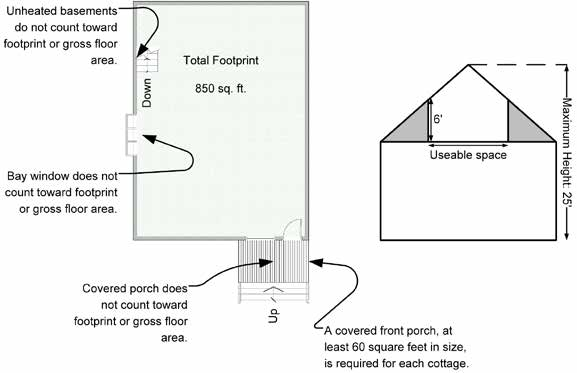
| Cottage size | Cottages may have no more than 1,200 sq. ft. of gross floor area, not including interior spaces with less than six ft. of overhead room, architectural projections (such as bay windows), basements, detached garages/carports and unenclosed porches. No unit may have more than 850 sq. ft. on its ground floor. The maximum height of a cottage is 25 feet. |
| Other characteristics | Depending on a community’s tastes, more control of the look of the cottages could be important to make sure the designs blend well with the neighborhood. In areas where cottages have drawn controversy, much of the opposition has been based on the aesthetics of the units. |
FIGURE 1
Example Cottage Housing Development

FIGURE 2
CHD Parking and Setback Details
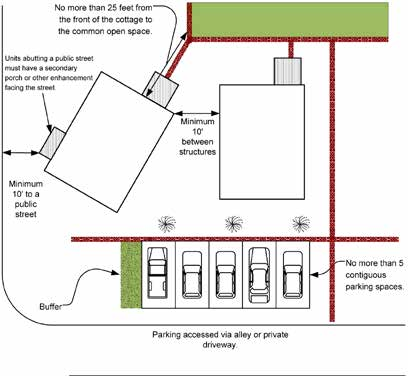
FIGURE 3
Example Cottage
MODEL REGULATIONS
Section 1: Intent
A) These regulations authorize Cottage Housing Developments (CHDs) as a permitted use in
certain residential zones with certain standards.
B) Cottage Housing is a type of housing appropriately sized for smaller households. This housing
type encourages efficient use of land, affordability and energy conservation. Cottage Housing allows for a higher density development than is normally allowed. This is made possible by smaller home sizes, clustered home sites and parking and design standards.
Section 2: Definitions
A) Cluster: A group of four to 12 cottages, arranged around a common open space.
B) Common open space: An area improved for passive recreational use or gardening. Common open spaces are required to be owned and maintained commonly, through a homeowners’ or
condominium association or similar mechanism.
C) Cottage: A single family detached dwelling unit that is part of a cottage housing development.
D) Cottage Housing Development (CHD): One or two clusters of cottages developed under a
single land development plan, or as part of another land development plan.
E) Footprint: The gross floor area of a cottage’s ground-level story.
Section 3: Districts
A) CHDs shall be permitted only in medium density single-family residential, and medium density
multi-family residential districts.
B) CHDs shall only be permitted in areas served by public sewer and water.
Section 4: Density
| Comment: There are three ways to achieve the density permitted, depending on the municipality’s zoning system: •Double the allowed units per acre; •Halve the minimum lot size requirement; •Allow two cottages on each single family lot. |
A) Cottages may be built at up to twice the underlying
zoned density for single family detached housing.
B) A CHD is composed of clusters of cottages.
1. Minimum units per cluster: 4
2. Maximum units per cluster: 12
3. Maximum clusters per CHD: 2
Section 5: Community Assets
A) Common open space
- Each cluster of cottages shall have common open space to provide a sense of openness and community for residents.
- At least 400 square feet per cottage of common open space is required for each cluster.
- Each area of common open space shall be in one contiguous and useable piece.
- To be considered as part of the minimum open space requirement, an area of common open space must have a minimum dimension of 20 feet on all sides.
- The common open space shall be at least 3,000 square feet in area, regardless of the number of units in the cluster.
- Required common open space may be divided into no more than two separate areas per cluster.
- At least two sides of the common open area shall have cottages along its perimeter.
- Parking areas, yard setbacks, private open space and driveways do not qualify as com- mon open space.
- Any municipal requirements for contributions to off-site recreation facilities shall be reduced for the CHD by the amount of common open space included in the development
B) Community Building
- Community buildings are permitted in CHDs.
- Community buildings shall be clearly incidental in use and size to dwelling units.
- Building height for community buildings shall be no more than one story.
Section 6: Ownership
A) Community buildings, parking areas and common open space shall be owned and maintained
commonly by the CHD residents, through a condominium association, a homeowners’ association, or a similar mechanism, and shall not be dedicated to the municipality.
Section 7: Design
A) Cottage Size
- The gross floor area of each cottage shall not exceed 1,200 square feet.
- At least 25% of the cottages in each cluster shall have a gross floor area less than 1,000 square feet.
- Cottage areas that do not count toward the gross floor area or footprint calculations are:
a. Interior spaces with a ceiling height of six feet or less, such as in a second floor area under the slope of the roof;
b. Basements;
c. Architectural projections—such as bay windows, fireplaces or utility closets—no greater than 24 inches in depth and six feet in width;
d. Attached unenclosed porches;
e. Garages or carports; - The footprint of each cottage shall not exceed 850 square feet
B) Unit Height
| Comment: While lots in a CHD do not have to abut public streets, private streets are not advisable because of concerns of shifting the burden to a municipality if the private entity can no longer maintain it, and private roads are often not constructed to municipal standards. |
| Comment: The International Fire Code, adopted by all municipalities in Pennsylvania, requires that access for fire apparatus “shall…extend to within 150 feet (45,720 mm) of all portions of the facility and all portions of the exterior walls of the first story of the building as measured by an approved route around the exterior of the building or facility (503.1.1).” |
- The maximum height of cottage housing units shall be 25 feet.
C) Orientation of Cottages
- Each dwelling unit shall be clustered around a common open space. Each unit shall have a primary entry and covered porch oriented to the common open space.
- Lots in a CHD can abut either a street or an alley.
- Each unit abutting a public street (not including alleys) shall have a façade, secondary en- trance, porch, bay window or other architectural enhancement oriented to the public street.
D) Cottage Setbacks
- The minimum setbacks for all structures (in- cluding cottages, parking structures and community buildings) in a CHD are:
a. Ten feet from any public right-of-way.
b. Ten feet from any other structure. - Cottages shall be no more than 25 feet from the common open area, measured from the façade of the cottage to the nearest delineation of the common open area.
- No part of any structure in the CHD (including but not limited to cottages, parking structures and community buildings) shall be more than 150 feet, as measured by the shortest clear path on the ground, from fire department vehicle access
E) Porches
| Comment: Municipalities may wish to include other design standards to address the specific aesthetic requirements of the community. |
- Cottage units shall have covered front porches.
The front porch shall be oriented toward the
common open space. - Covered porches shall have at least 60 square
feet in area.
F) Basements
- Cottages may have basements.
Section 8: Parking
A) Minimum Number of Off-Street Parking Spaces
- Units up to 700 square feet: 1 space per dwelling unit.
- Units 701-1000 square feet: 1.5 spaces per dwelling unit, rounded up to the next whole
number. - Units with more than 1000 square feet: 2 spaces per dwelling.
- The CHD shall include additional guest parking. A minimum of .5 guest parking spaces
per dwelling unit, rounded up to the next whole number, shall be provided for each cottage
cluster. Guest parking may be clustered with resident parking, however, the spaces shall
include clear signage identifying them as reserved for visitors. - The requirement for off-street parking may be waived or reduced by the municipality if suf-
ficient on-street parking is available.
B) Parking Design
- Parking shall be separated from the common area and public streets by landscaping and/
or architectural screening. Solid board fencing shall not be allowed as an architectural
screen. - Parking areas shall be accessed only by a private driveway or a public alley.
- The design of garages and carports—including roof lines—shall be similar to and compat-
ible with that of the dwelling units within the CHD. - Parking areas shall be limited to no more than five contiguous spaces.
Section 9: Walkways
- A CHD shall have sidewalks along all public streets.
- A system of interior walkways shall connect each cottage to each other and to the parking
area, and to the sidewalks abutting any public streets bordering the CHD. - Walkways and sidewalks shall be at least four feet in width.